This document describes the conditions under which data acquired outside the scope of Epos-France can be integrated into the seismological data center for archiving and distribution.
Conformance language
The key words MUST, MUST NOT, REQUIRED, SHOULD, SHOULD NOT, and MAY in this document are to be interpreted as described in RFC 2119 and RFC 8174, when, and only when, they appear in all capitals.
Service description
Epos-France Seismological Information System (SIS) collects, validates, hosts and distributes seismological data and metadata in the scope of all Epos-France activities.
It mints and manages persistent object identifiers following best practices to maximize data findability.
It guarantees long term hosting and online availability of all the seismological data.
The seismological data center (sometimes referred to as B-node) is certified as a trustworthy data repository by Core Trust Seal.
Epos-France SIS can also provide those services to external entities through a specific process called “Integration of non Epos-France datasets”. This service is conditioned by a scientific and technical validation and the purpose of this document is to describe the requirements and the process to benefit from this service.
Once a dataset is approved, there is no distinction made with Epos-France data sets. Same rules and same services apply equally. Our data services are advertised on the seismological data portal (https://seismology.epos-france.fr/).
Eligibility
This service is accessible for any seismological dataset where the principal investigator is an academic researcher from a french institution. For other type of requests, the steering committee will decide on a case-by-case basis whether the data can be handled by EPOS-France.
Requirements for Integration into Epos-France
Any academic dataset can potentially be integrated into EPOS-France.
If a data producer cannot meet some of the requirements (see below) but still needs to distribute their data through Epos-France, they may submit an application with a scientific justification. The Steering Committee will then assess possible solutions for data integration or alternative solutions.
Data producer requirements
- The EPOS-France data centre will be the sole distribution centre for the data. If the data were previously distributed by another centre (e.g. EarthScope), the project leader MUST close that distribution channel.
- Data MUST be in MiniSEED int32 STEIM2 format
- The Dataset MUST be presented as one file per channel per day
- The data set SHOULD be organized using a standard SDS directory structure
- Metadata MUST be in StationXML v1.2 format.
- Sampling rate MUST NOT exceed 250 Hz.
- Total dataset size MUST NOT exceed 5 TB.
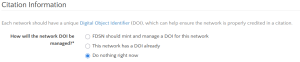
- The FDSN network code MUST be created by the Principal Investigator (PI) beforehand, without any DOI, see appendix 1 for the detailed procedure; the DOI will be created and managed by EPOS France.
- Data and metadata MUST be provided to the A-node simultaneously with the transfer method they support
- Mandatory information to set up the DOI metadata MUST be provided to the A-node following their procedure
- A new request MUST be submitted with the official online form
Data Licence and citation
Epos-France fosters open data licences and distributes data under the terms of the Creative Commons with Attribution clause ( CC-BY 4.0).
The data will be publicly available as soon as it is integrated into the data center. Once the metadata is integrated, a DOI and a landing page are generated, allowing the network to be cited in publications.
Datacite metadata will contain information the PI writes in the initial application form. Further changes in the DOI must be asked to sismo-help@epos-france.fr
We strongly recommend that the DOI is managed by the Epos-France data center. If, for any justified reason, this is not possible, then at least one A node must be the manager of the DOI. In this case, the Datacite metadata SHOULD conform to the Epos-France recommendations.
If a DOI already exists, the A node will take care of creating a new DOI and realize the relationship between them, making sure the obsoleted DOI redirects to the new one.
When to Submit Your Data Integration Request
We recommend submitting your request before data acquisition begins.
If the dataset is funded by ANR or ERC funders, the request SHOULD be made before the project submission The Principal Investigator has to make sure the distribution is accepted before mentioning it in the Data Management Plan.
Cost
For academical partners (french universities, CNRS, CEA, and other french public institutions), Epos-France offers this service for no cost.
A financial contribution may apply for non-academic partners, or if the request is not submitted by a researcher from a French institution.
Admission Process and how to submit a hosting request
Admission to integrate a dataset into the data center is obtained in two steps:
- Data owner submit a request through the official online form
- The Epos-France technical committee identifies the best A-node to endorse the request
- The A-Node verifies that all technical requirements are met and all the necessary information is available.
- The A-Node transmits the request to the Steering Committee for approbation
- Upon approval, the A-Node will undertake the necessary work to integrate the data and metadata. If approval is not granted, the Steering Committee will arrange a discussion with the PI to explore potential solutions.
If the data acquisition is planned to last more than one year, the Steering Committee will review the project annually to make sure all requirements are met.
Appendix
Making sure FDSN does not mint a DOI for the network code
At the FDSN, when filling the form of a new network code (https://www.fdsn.org/networks/request) the “Citation Information” section has several optiosn. Choose “Do nothing right now”. See screen shot: